April blurb: stochastic collocation methods
1. Problem statement: sample tough distributions accurately and fast
Suppose you want to sample a normal distribution, and are only able
to produce uniform variates. How can you do it? One option is to use
the Box--Müller method: sample two uniform variates $(u,v)$
and set
$$(x,y) = \left(\sqrt{-2\log u} \cos(2\pi v), \sqrt{-2\log u} \sin(2\pi v)\right).$$
Then $(x,y)$ is 2-dimensional standard normal, and $x$ is a standard
Gaussian distribution. You could also sample a single uniform $u$ and
use an efficient and accurate implementation of $\Phi^{-1}(u)$, the
percentage point function (PPF) of the standard normal distribution. But
what about more complex distributions? For example, sampling a non-central
$\chi$-squared distribution requires inverting a cumulative distribution
function (CDF) defined by a convergent infinite series. For a handful of
computations, this is fine. For a few millions, it is infeasible.
This paper
proposes a smarter way to do it: sample the expensive PPF
$\Psi^{-1}(\Phi(x))$ at finitely many strategically chosen normal deviates
$x_1,\ldots,x_n \in\mathbb R$, and call the outputs $y_1,\ldots,y_n$. Then,
use a family of functions $L_1(x),\ldots,L_n(x)$ such that $L_i(x_j) = \delta_{ij}$
and replace $g(x) = \Psi^{-1}(\Phi(x))$ by
$$\hat{g}(x) = \sum_{i=1}^n y_i L_i(x) .$$
2. Test case: the inverse Gaussian distribution
The inverse Gaussian (IG) distribution has positive parameters
$\mu$ and $\lambda$ and arises naturally as the distribution of the
first-passage time of a Brownian motion with drift. Concretely, if $W_t$
is a standard Brownian motion and $\nu, a$ are positive constants, then
the hitting time $\tau = \inf\{t \ge 0 : \nu t + W_t = a\}$ follows an
IG distribution with $\mu = a/\nu$ and $\lambda = a^2$.
Its probability density function is $$f(x;\mu,\lambda) =
\sqrt{\frac{\lambda}{2\pi
x^3}}\exp\!\left(-\frac{\lambda(x-\mu)^2}{2\mu^2 x}\right), \quad
\text{for positive } x,$$ and its cumulative distribution function
admits the closed form $$F(x;\mu,\lambda) =
\Phi\!\left(\sqrt{\frac{\lambda}{x}}\left(\frac{x}{\mu}-1\right)\right)
+
e^{2\lambda/\mu}\,\Phi\!\left(-\sqrt{\frac{\lambda}{x}}\left(\frac{x}{\mu}+1\right)\right),$$
where $\Phi$ denotes the standard normal CDF. Although the CDF is
available in closed form, inverting it is not straightforward. Indeed,
decomposing each argument as $\sqrt{\lambda/x} = v/2$ and $\sqrt{\lambda
x}/\mu = k/v$ (which is consistent precisely when $k = 2\lambda/\mu$),
the two $\Phi$-arguments become $k/v + v/2$ and $k/v - v/2$, and we
recognise $$1 - F(x;\mu,\lambda) = f^{-1}\,\mathrm{Call}(f,K,v),$$ the
Black--Scholes call price (divided by the forward $f$) with
log-moneyness $k = \log(K/f)$ and total volatility $v$. Inverting the IG
CDF at a given probability level is therefore exactly as hard as finding
the implied volatility of a call option!
Let us test how well this performs for some values of $\mu$ and
$\lambda$. I implemented the algorithm in the paper in Go
and compared the output with what SciPy returns. The results are
quite decent using 9 collocation points:
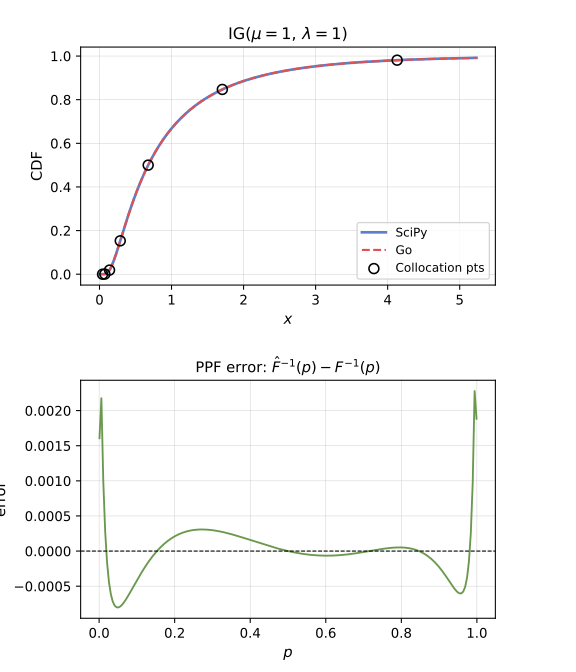
Figure 1. $\mathrm{IG}(\mu=1,\lambda=1)$.
Top: CDF computed analytically in Go (red dashed) vs. SciPy (blue solid);
circles are the 9 stochastic collocation nodes (two far-tail nodes omitted from the plot).
Bottom: PPF approximation error $\hat{F}^{-1}(p)-F^{-1}(p)$.
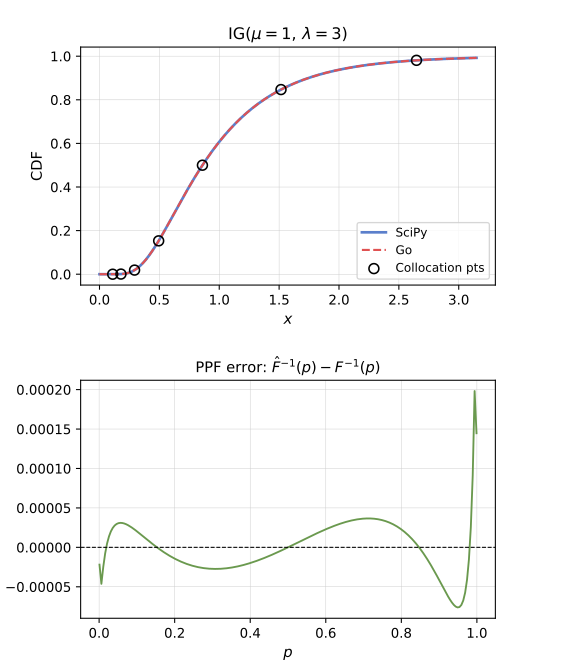
Figure 2. $\mathrm{IG}(\mu=1,\lambda=3)$: higher shape parameter,
lighter tail.
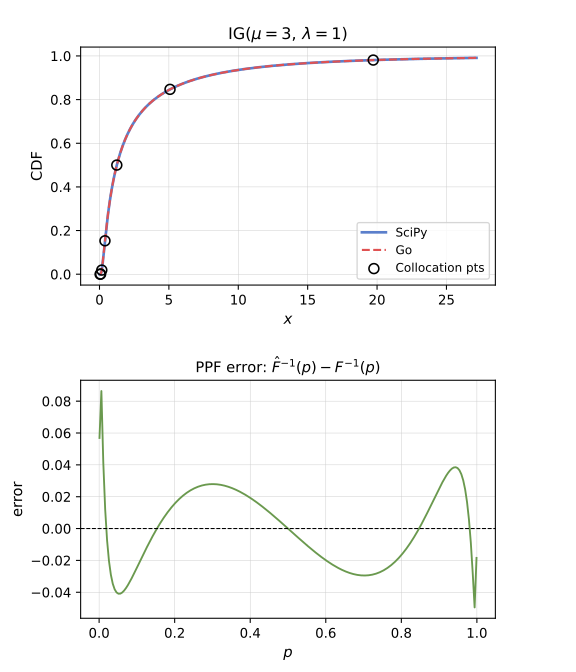
Figure 3. $\mathrm{IG}(\mu=3,\lambda=1)$: larger mean,
heavier tail.
Finally, let us check how the error behaves as we produce more collocation
points:
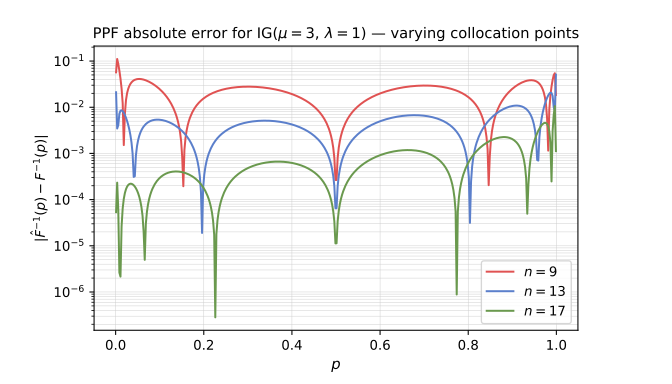
Figure 4. PPF approximation error (log scale) for $\mathrm{IG}(\mu=3,\lambda=1)$
as the number of collocation nodes increases from 9 to 13 to 17.
References
For further reading, see:
-
L. A. Grzelak, J. Witteveen, M. Suarez-Taboada, C. W. Oosterlee;
The Stochastic Collocation Monte Carlo Sampler: Highly Efficient Sampling from 'Expensive' Distributions;
Quantitative Finance, 2018.
-
M. C. W. Tweedie; Statistical properties of inverse Gaussian distributions;
Annals of Mathematical Statistics, 28(2):362--377, 1957.
-
V. Seshadri; The Inverse Gaussian Distribution: Statistical Theory and Applications;
Springer, 1998.
-
W. H. Press, S. A. Teukolsky, W. T. Vetterling, B. P. Flannery;
Numerical Recipes: The Art of Scientific Computing, 3rd ed.;
Cambridge University Press, 2007.
(Gauss–Hermite quadrature and Lagrange interpolation.)