June: a neat use of the Doob transform
Let us consider the following problem, which is closely related to
the Moran process
[5], or equivalently the voter model on the complete
graph [1, 4].
Consider a box with $N$ balls, each painted with a different colour.
Then, pick two balls without replacement, and paint the first one the
same colour as the second one. What is the expected number of steps until
your box consists of balls of the same colour? Running a simulation reveals
that for $N$ balls, the expected number of steps is $(N-1)^2$. But how
to prove this?
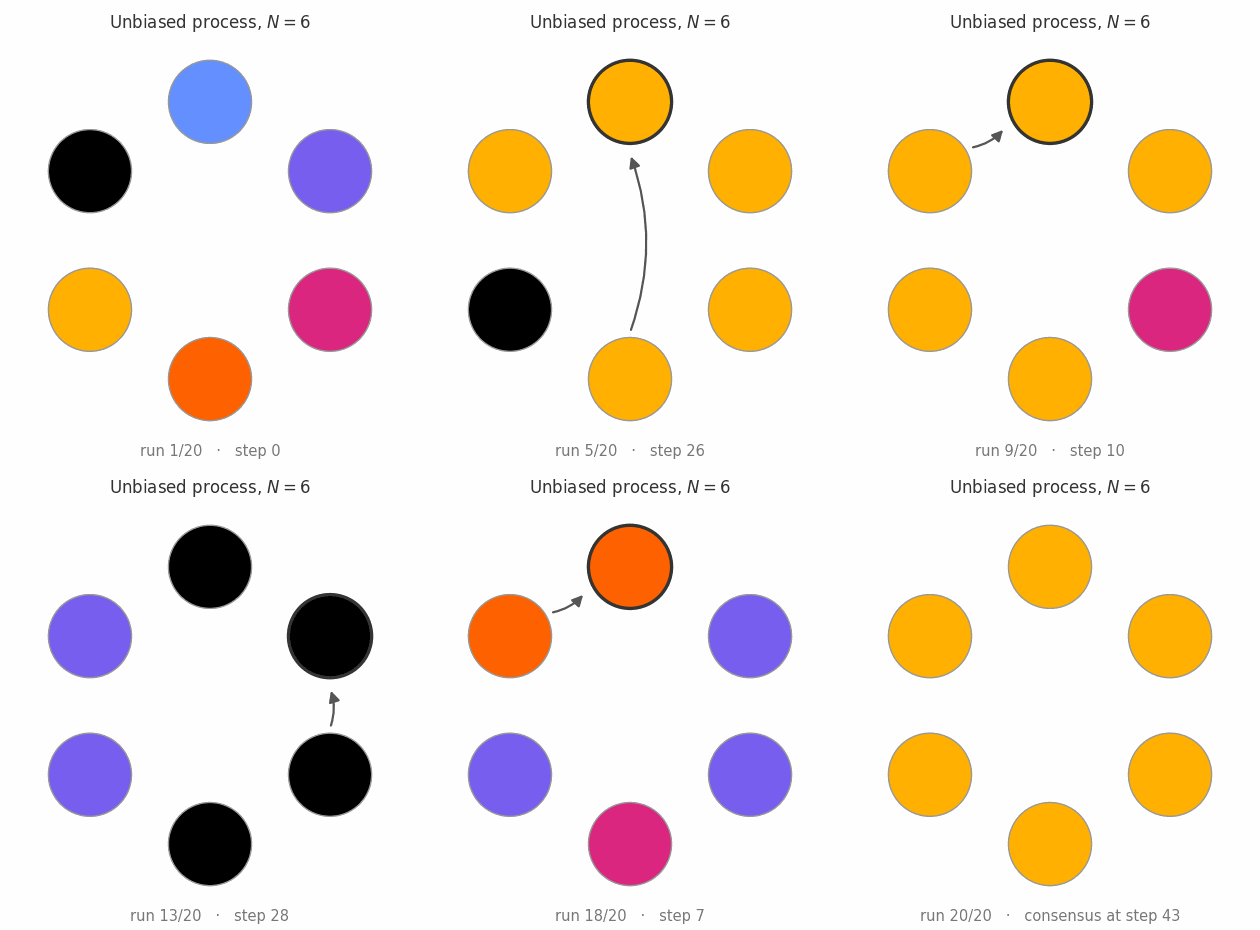
Figure 1. Twenty sample paths of the unbiased process for
$N=6$: at each step an ordered pair of balls is drawn without
replacement and the first is painted the colour of the second (the
arrow points from the donor to the repainted ball), until consensus.
Every colour is equally likely to take over.
Begin by letting $X^c(t)$ denote the number of balls of colour $c\in [N]$
at time $t$. It is clear that if $X^c(t) = n$, then
$X^c(t+1) \in \{n, n-1, n+1 \}$, and the probability of losing
or gaining one more ball is the same, equal to $\frac{n}{N} \frac{N-n}{N-1}$.
So the individual processes $X^c$ (which are all identically distributed)
are easy to describe. But the hitting time $T$ mixes them together,
making the analysis a bit complicated, and here is where the Doob
transform makes its entry.
First, note that the probability of ending up at either colour is
the same by symmetry (assuming we already know that $\mathbb E(T)$ is finite
almost surely), and thus equal to $N^{-1}$. Moreover,
$$
\mathbb E(T) = N^{-1}\sum_{c\in [N]} E(T \mid \text {$c$ wins}) =
E(T \mid \text {$c_0$ wins})
$$
where $c_0$ is a particular colour, again by symmetry. So all we
need is to compute the same expected value, but for a process which
we know will always end up at $c_0$. In other words, we need to
deal with a conditional hitting time. This is precisely what
we can do using the Doob transform! We will simply slightly change the
distribution of $X^c(t)$ so that
$$
\mathbb E(T \mid \text {$c$ wins and $X^c(0) = 1$} ) = \widetilde{\mathbb E}(T \mid X^c(0) = 1)
$$
where $\mathbb E$ is computed under the new measure.
The Doob transform
The Doob $h$-transform [2] is a recipe for turning a
Markov chain into the chain obtained by conditioning it to do something;
for textbook treatments see [3, 6].
Let $X(t)$
be a Markov chain on some state space $S$ with
transition matrix $P$, so that
$$P(x,y) = \mathbb P(X(t+1) = y \mid X(t) = x).$$
Suppose $h\colon S \to [0,\infty)$ is a nonnegative function that is
harmonic at every non-absorbing state, meaning
$$
(Ph)(x) = \sum_{y\in S} P(x,y)\, h(y) = h(x).
$$
Then, at every state $x$ with $h(x) > 0$ we may define a new transition matrix by tilting
the old one:
$$
\widetilde P(x,y) = \frac{h(y)}{h(x)}\, P(x,y).
$$
Since $h$ is harmonic, we obtain a stochastic matrix, and
the chain $\widetilde X$ governed by $\widetilde P$ is called the Doob
transform of $X$ by $h$.
In our case, the useful choice of $h$ is a hitting probability. Fix a target set
$A \subseteq S$ of states and let
$$
h(x) = \mathbb P(\text{the chain is absorbed at $A$ starting from $x$}).
$$
By a one-step decomposition [6] this $h$ is harmonic away from
the absorbing states, and the Doob transform $\widetilde P$ is precisely
the law of the original chain conditioned on the event that it
ends up in $A$. Indeed, for any path $(x_0, x_1, \dots, x_t)$ the
conditional probability telescopes
$$
\mathbb P\big(X(1) = x_1,\dots, X(t) = x_t \mid X(0) = x_0,\ \text{end in } A\big)
= \prod_{s=0}^{t-1} \frac{h(x_{s+1})}{h(x_s)}\, P(x_s, x_{s+1}),
$$
because the intermediate factors $h(x_1),\dots,h(x_{t-1})$ cancel and only
the endpoints survive. So conditioning on the far-off event "we eventually
reach $A$" is, step by step, nothing more than reweighting each transition
by the ratio $h(y)/h(x)$.
Applying it to our case, we first need to compute
$h(n)$, the probability of ending up at our favourite colour $c_0$
only, provided we start with $n < N$ balls of colour $c_0$.
Obviously $h(0)=0$ and $h(N)=1$, and because of chain is symmetric,
we see that the condition that $h$ be harmonic is
$$h(n) = \frac 12 h(n+1) + \frac 12 h(n-1),$$
so that $h(n) = \frac nN$. Reweighing the chain using this
$h$ leads us to the transition probabilities
$$
p^{\uparrow}(n) = \frac{N-n}{N(N-1)} (n+1),\qquad
p^{\downarrow}(n) = \frac{N-n}{N(N-1)} (n-1)\\
p^{\circlearrowleft}(n) = 1- 2n\frac{N-n}{N(N-1)} \\
$$
where we now clearly see that the chain is biased to push up, as it
should be.
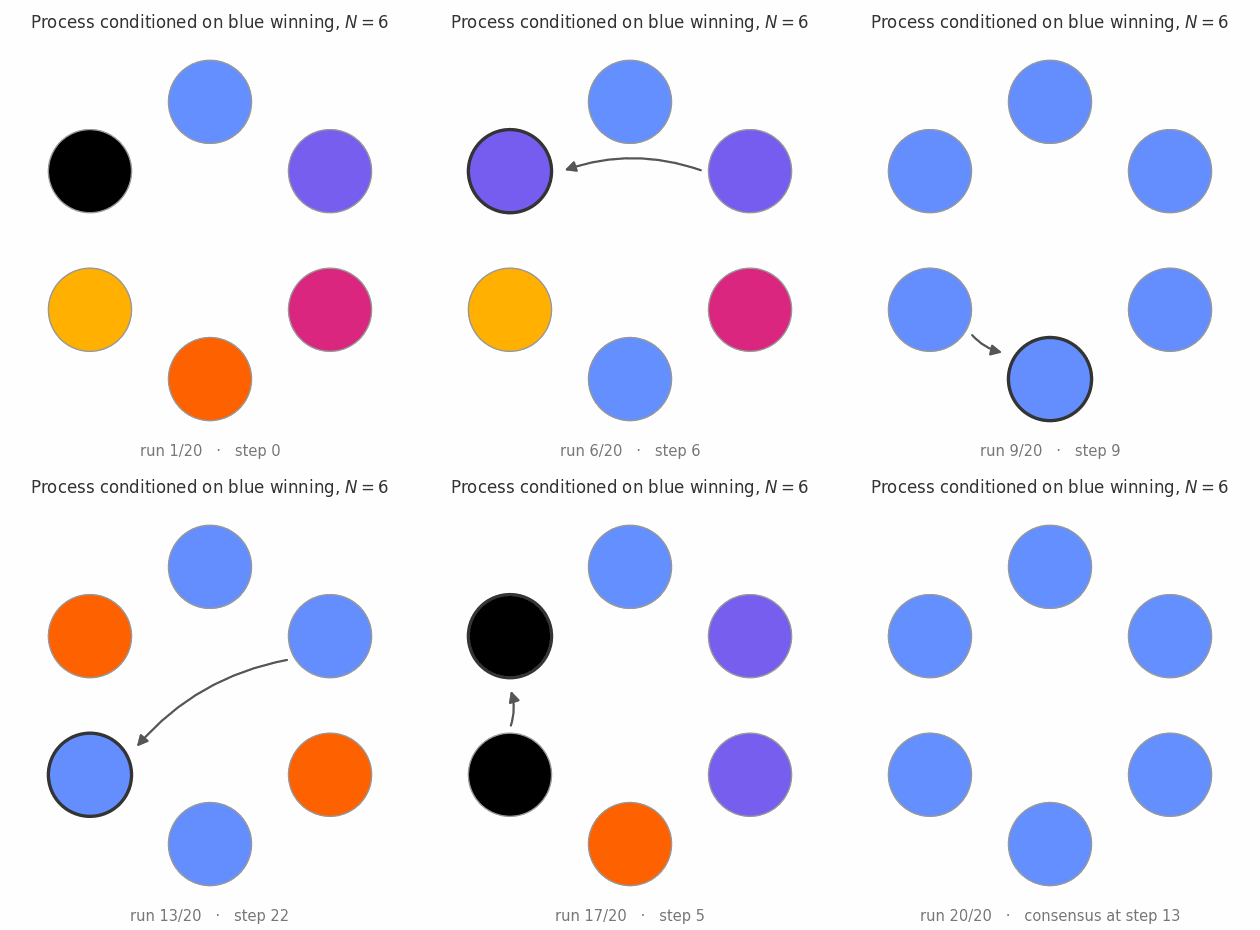
Figure 2. Twenty sample paths of the conditioned process, that
is, of the Doob transform of the chain by the hitting probability
$h(n) = n/N$. The dynamics look identical step by step, but every
path now ends in blue consensus. (The paths are sampled by rejection,
which produces exactly the conditioned law.)
Using this new chain, let $e(n) = \widetilde{\mathbb E}(T \mid X^c(0) = n)$
and note that
$$ e(n) = 1 + p^{\uparrow}(n) e(n+1) + p^{\downarrow}(n) e(n-1) +
p^{\circlearrowleft}(n) e(n) $$
or, what is the same, that
$$ e(n) = w(n) + q^{\uparrow}(n) e(n+1) + q^{\downarrow}(n) e(n-1)
$$
where $w(n) = (p^{\uparrow}(n)+p^{\downarrow}(n))^{-1}$
is the average time spent at the loop, and $q$ is obtained
by normalizing the $p$ probabilities, so that
$$
q^{\uparrow}(n) = \frac{1}{2} + \frac 1 {2n},\qquad
q^{\downarrow}(n) = \frac{1}{2} - \frac 1 {2n},\qquad
w(n) = 2n\frac{N-n}{N(N-1)}.
$$
Of course, we are after $e(1)$.
As a concrete illustration, for $N=6$ the tridiagonal system $(I-\tilde P)\mathbf e = \mathbf 1$
is:
$$
\begin{pmatrix}
1/3 & -1/3 & & & \\
-2/15 & 8/15 & -2/5 & & \\
& -1/5 & 3/5 & -2/5 & \\
& & -1/5 & 8/15 & -1/3 \\
& & & -2/15 & 1/3
\end{pmatrix}
\begin{pmatrix} e(1)\\
e(2)\\
e(3)\\
e(4)\\
e(5)\end{pmatrix}
=
\begin{pmatrix}1\\1\\1\\1\\1\end{pmatrix}
$$
If we now use the usual algorithm to solve tridiagonal systems,
something good happens: the $c'$ coefficients are all $-1$, and
so the back-substitution to solve for $\mathbf e$ leads to
$$e(1) = \sum_{n=1}^{N-1} d(n), \qquad d(n) := e(n)-e(n+1)$$
with
$$
d(n) = \frac{N(N-1)}{(N-n)(n+1)} + \frac{n-1}{n+1}\,d(n-1), \qquad d(1) = \frac{N}{2}
$$
Note that $d(1) = e(1) - e(2)$ can be computed from the original recursion
and is equal to $w(1)$. A little bit of algebra reveals that
$$d(n) = \frac{N}{n(n+1)} + \frac{N(N-1)}{n(n+1)}\sum_{j=2}^{n}\frac{j}{N-j}$$
and the sum collapses to $(N-1)^2$.
Some bonus results
The computation above gave us $e(1)$, but with a little more work the same
ideas give a closed formula for every $e(n)$. The key observation
(which we already made) is that the differences $d(n) = e(n) - e(n+1)$
satisfy a first order
linear recurrence, and those can be solved systematically. Indeed,
rearranging the one-step equation for $e(n)$ gives
$$ p^{\uparrow}(n)\, d(n) = 1 + p^{\downarrow}(n)\, d(n-1), $$
which is the recursion for $d$ from the previous section
written in a perhaps cleaner way.
A summation factor. Just as a first order linear ODE is solved
by an integrating factor, a recurrence of this shape telescopes after
multiplying through by a well-chosen summation factor: we look
for positive numbers $\pi_n$ such that
$$ \pi_n\, p^{\downarrow}(n) = \pi_{n-1}\, p^{\uparrow}(n-1), $$
because then $F(n) = \pi_n\, p^{\uparrow}(n)\, d(n)$ satisfies
$F(n) = \pi_n + F(n-1)$, and therefore
$$ F(n) = \sum_{j=1}^{n} \pi_j. $$
The defining condition only couples neighbours, so it determines
$\pi_n$ up to a constant through a telescoping product: normalizing
$\pi_1 = 1$,
$$ \frac{\pi_n}{\pi_{n-1}} = \frac{p^{\uparrow}(n-1)}{p^{\downarrow}(n)}
= \frac{n(N-n+1)}{(n-1)(N-n)}
\quad\Longrightarrow\quad
\pi_n = \frac{n(N-1)}{N-n}. $$
Note that
$$ \pi_n\, p^{\uparrow}(n) = \frac{n(n+1)}{N}, $$
so this is precisely the multiplication by $n(n+1)$ that made the
computation of $e(1)$ work — and also the reason all the $c'$
coefficients in the tridiagonal elimination came out equal to $-1$.
Remark. In probability, $\pi$ is called a reversible
measure for the chain, and the relation defining it is the
detailed balance equation: it says that the matrix
$\widetilde P$ becomes self-adjoint with respect to the inner product
weighted by $\pi$. A birth–death chain always admits such a
measure, since detailed balance only constrains neighbouring states
— which is why hitting times of one-dimensional chains are always
explicitly summable, by the very computation we are doing here.
Solving for $d$. Writing $\frac{j}{N-j} = \frac{N}{N-j} - 1$,
the sum of the summation factors is
$$ F(n) = \sum_{j=1}^n \pi_j = (N-1)\sum_{j=1}^n \frac{j}{N-j}
= (N-1)\left[ N\left( H_{N-1} - H_{N-n-1} \right) - n \right], $$
where $H_m = 1 + \frac 12 + \cdots + \frac 1m$ is the $m$-th harmonic
number. Hence
$$ d(n) = \frac{N\,F(n)}{n(n+1)}
= \frac{N(N-1)}{n(n+1)}
\left[ N\left( H_{N-1} - H_{N-n-1}\right) - n \right]. $$
Summing back up. Since $e(N) = 0$, we have
$e(n) = \sum_{k=n}^{N-1} d(k)$. Abbreviating
$g(k) = H_{N-1} - H_{N-k-1}$ and splitting
$\frac{1}{k(k+1)} = \frac 1k - \frac{1}{k+1}$, this reads
$$ \frac{e(n)}{N(N-1)}
= N \sum_{k=n}^{N-1} g(k)\left( \frac 1k - \frac 1{k+1}\right)
- \sum_{k=n}^{N-1} \frac{1}{k+1}. $$
The second sum is $H_N - H_n$. The first is handled by summation by
parts, using $g(k+1) - g(k) = \frac{1}{N-k-1}$:
$$ \sum_{k=n}^{N-1} g(k)\left( \frac 1k - \frac 1{k+1}\right)
= \frac{g(n)}{n} - \frac{H_{N-1}}{N}
+ \sum_{k=n}^{N-2} \frac{1}{(k+1)(N-k-1)}, $$
and the remaining sum evaluates by partial fractions,
$\frac{1}{(k+1)(N-k-1)}
= \frac 1N \left( \frac{1}{k+1} + \frac{1}{N-k-1} \right)$, to
$\frac 1N \left( H_{N-1} - H_n + H_{N-n-1}\right)$. Assembling the
pieces, nearly everything cancels and we are left with
$$
e(n) = (N-1)\left[\frac{N(N-n)}{n}
\left(H_{N-1}-H_{N-n-1}\right)-1\right],
$$
where the harmonic-number difference is just
$\sum_{j=N-n}^{N-1} \frac 1j$. At $n=1$ this collapses to
$(N-1)\left[N(N-1)\cdot\frac{1}{N-1}-1\right]=(N-1)^2$, recovering the
main result, while at $n=N-1$ it gives $e(N-1) = N H_{N-1}-(N-1)$:
even one step away from consensus, the conditioned chain still needs
about $N\log N$ steps to finish!
Finally, since consensus with colour $c$ winning is exactly the event
that $X^c$ hits $N$, and $c$ wins with probability $n_c/N$, the
unconditional expected consensus time from any starting
configuration with colour counts $(n_1,\dots,n_k)$ is
$$
\mathbb E(T)=\frac{1}{N} \sum_{c}n_c \,e(n_c).
$$
The all-distinct start ($n_c\equiv 1$) gives
$N\cdot\frac 1N\,e(1)=(N-1)^2$ again, and the two-colour case
reproduces the classical consensus time for the voter model on the
complete graph [1].
References
-
Cox, J. T. (1989), "Coalescing Random Walks and Voter Model Consensus
Times on the Torus in $\mathbb Z^d$," The Annals of Probability,
17(4), 1333–1366.
-
Doob, J. L. (1957), "Conditional Brownian Motion and the Boundary
Limits of Harmonic Functions," Bulletin de la Société Mathématique
de France, 85, 431–458.
-
Levin, D. A. and Peres, Y. (2017), Markov Chains and Mixing
Times, 2nd ed., American Mathematical Society, Providence.
-
Liggett, T. M. (1985), Interacting Particle Systems, Springer,
New York.
-
Moran, P. A. P. (1958), "Random Processes in Genetics,"
Mathematical Proceedings of the Cambridge Philosophical
Society, 54(1), 60–71.
-
Norris, J. R. (1997), Markov Chains, Cambridge University
Press, Cambridge.